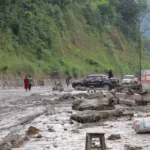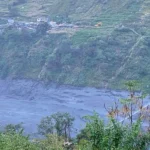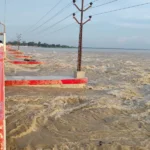


Kathmandu: A devastating flood suddenly struck Rasuwa on Wednesday morning, causing extensive damage in areas including Timure and Syafrubesi. Preliminary information indicates that an unusually large volume of floodwater entered the Bhotekoshi River from the Tibetan side. However, the exact source and cause of the flood have not yet been confirmed.
According to the Flood Forecasting Section of the Department of Hydrology and Meteorology, the flood entered the Bhotekoshi from the Tibetan side at around 9:15 a.m., causing the river’s water level to rise suddenly. Preliminary reports indicate damage to markets, settlements, roads, bridges, and hydropower projects in Timure and Syafrubesi.
Rasuwa Chief District Officer Narendra Pariyar said there had been no significant rainfall around the district headquarters before the flood. He said the flood occurred suddenly and its source has not yet been established.
Glacial Lake Outburst Suspected
Based on the nature of the flood and the sudden influx of a large volume of water from Tibet, authorities have preliminarily suspected that a glacial lake in Tibet may have burst, triggering a Glacial Lake Outburst Flood (GLOF).
According to the Flood Forecasting Section, the flood occurred suddenly and there was no immediate indication of a direct connection with local rainfall. Authorities are therefore studying the possibility of a GLOF. Coordination with the Chinese side and analysis of satellite imagery are underway to determine the actual cause.
However, no specific glacial lake has yet been confirmed to have burst. Therefore, scientifically, it would be premature to definitively classify the event as a GLOF at this stage.
Major Damage in Timure and Syafrubesi
The sudden flood caused significant damage around the Rasuwagadhi border crossing and Timure. Preliminary reports indicate damage to market areas, the customs compound, bridges and other infrastructure. Several hydropower projects have also been affected.
Authorities have urged residents in riverine areas of Rasuwa, Nuwakot, Dhading, Gorkha and Chitwan to remain highly alert, as the flood could move downstream. Since the flood may travel through the Trishuli River toward Muglin, people living or travelling along the riverbanks have been advised to exercise particular caution.
How Can Such a Huge Flood Occur Without Rainfall?
Floods are generally associated with heavy rainfall. However, in mountainous regions, catastrophic flooding can occur even when there is little or no rainfall locally. Water can accumulate suddenly in higher elevations, or large volumes of water can be released from glaciers or glacial lakes.
A glacial lake outburst is one such process. As glaciers melt, water can accumulate behind natural ice or moraine dams. If these natural barriers weaken or collapse because of landslides, unstable ice or other factors, large volumes of water can be released suddenly. This can develop into a destructive flood within minutes or hours, making early warning and preparedness crucial for downstream communities.
Rasuwa Faces a Similar Risk Again After One Year
Rasuwa also experienced a devastating flood originating from the Tibetan side on June 26, 2025. Studies conducted after that event concluded that a sudden release of water from a glacial lake in the Purepu Glacier area of Tibet caused the major flood that reached Nepal.
It is not yet possible to determine whether the current event is directly connected to the same glacial lake or the same area. New satellite imagery and technical investigations will be required.
However, the recurrence of such events highlights the urgent need to strengthen forecasting, monitoring and cross-border information sharing regarding glacial lakes and glacier-related hazards in the Nepal–Tibet Himalayan region.
What Is the Connection With Climate Change?
A single GLOF event cannot automatically be concluded to be a direct consequence of climate change. However, scientific studies indicate that rising temperatures, accelerated glacier melt and the formation of new and larger glacial lakes in the Himalayas can increase GLOF risks.
Therefore, even if today’s Rasuwa flood is eventually confirmed to have been caused by a GLOF, its immediate trigger and its longer-term climate context must be understood separately.
The Immediate Question: What Actually Happened in Tibet?
The key question remains: What actually happened on the Tibetan side?
Nepali authorities are currently awaiting satellite imagery, river-flow data and information from the Chinese side. Only these sources will help establish whether the flood was caused by a glacial lake outburst, another glacier-related event, or a different cause altogether.