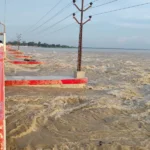


Kathmandu – Experts and disaster management specialists have called for stronger preparedness, better early warning systems and greater investment in disaster risk reduction following the devastating Rasuwa–Bhotekoshi floods of 2026.
Speaking at an Inter-City Meeting titled “From Catastrophe to Preparedness: Understanding Rasuwa–Bhotekoshi Floods 2026 and Managing Himalayan Floods” held at Hotel Radisson on Sunday, experts discussed the causes and impacts of the flood, challenges faced during rescue operations and the need to strengthen Nepal’s disaster preparedness.
The programme was hosted by the Rotary Club. The welcome session was attended by Rashmi Pokhrel, President of Rotary Club of Rajdhani; Vishnu Bahadur Karkee, District Governor; and Anish Bajracharya, Chair of the Inter-City Meeting. Dr. Nirmal Rijal moderated the programme.
Flood risk is becoming more complex
Dr. Meen Bahadur Poudyal Chhetri, Immediate Past President and Executive Director of the Nepal Center for Disaster Management (NCDM), described the Bhotekoshi disaster as a complex cascading disaster.
He said Nepal needs stronger technological capacity for disaster preparedness, including its own satellite system. During the Bhotekoshi flood, Nepal had to depend on satellite information from China, highlighting the need to develop national capacity for disaster monitoring and preparedness.
He also praised the rescue efforts of the Nepal Police and Nepal Army during the disaster.
More glacial lakes pose growing danger
Dr. Nitesh Khadka, a researcher in cryosphere and glacial hazards, presented a study on the massive rock-ice avalanche and debris flow along the Bhotekoshi–Trishuli river system.
He said climate change is affecting glacial rivers and that more than 100 glacial lakes are at risk of outburst. According to his presentation, 45 glacial lake outburst flood (GLOF) incidents have been recorded so far, including 24 in Nepal.
Explaining the Bhotekoshi disaster, Khadka said a massive rock-ice avalanche fell from a height of about 1,220 metres. The process caused fragmentation, entrainment, friction and melting, eventually increasing the mobility of the material and triggering a powerful debris flow.
The debris flood moved at extremely high speeds at different locations. It reached about 188 km per hour at Rasuwagadhi, 120 km per hour at Safrubeshi and 122 km per hour at Mailung. The speed was still around 82 km per hour at Betrawati, 58 km per hour at Devighat and 52 km per hour at Galchhi.
Khadka stressed that Nepal must invest in disaster preparedness before disasters occur rather than spending only after disasters strike.
Only minutes available to respond
Dr. Shravan Kumar Ghimire, a human geographer and spatial analyst, presented a study on the impacts of the Rasuwa–Bhotekoshi flood on infrastructure, accessibility and socio-economic conditions.
He described the debris flood as unpredictable and unprecedented. Although there were technically around seven minutes for a response at Rasuwagadhi, he said there was practically no time for people to react.
According to his presentation, the government issued a flood warning 31 minutes after the flood had already hit Rasuwagadhi.
The disaster swept away 105 bridges and affected an area where more than 8,000 people had been living along the flood path. The estimated damage included around Rs 40 billion in building structures and Rs 25 billion in household property.
Ghimire said the flood was around 270 times greater than the normal river flow, demonstrating the scale and destructive power of the event.
Rescue operations faced major challenges
Col. (Retd.) Ratindra Khatri, a disaster preparedness and response specialist, discussed the challenges faced during disaster response and rescue operations.
Drawing on his experience of responding to major disasters, including the 2045 BS earthquake and the Haiti earthquake, Khatri said the Bhotekoshi disaster presented several unique challenges.
One of the biggest difficulties was rescue inside tunnels. There was no previous experience of tunnel rescue in such circumstances, while debris accumulated inside the tunnel and made rescue operations even more difficult.
He identified difficult terrain and limited accessibility, adverse weather, communication disruptions, limited response time, remote and scattered settlements, coordination problems, logistical constraints and inadequate community preparedness as major challenges during the rescue operation.
Focus must shift from response to preparedness
The discussions highlighted the need to strengthen Nepal’s disaster preparedness system, particularly in the Himalayan region where climate change, glacial hazards and extreme events are creating new risks.
Experts emphasized the importance of timely warnings, better technology, stronger communication systems, community preparedness and investment in disaster risk reduction.
The programme concluded with an interactive question-and-answer session in which participants raised questions with the speakers on disaster risks, preparedness and response.